 The Joyful Exhale
You’re in a folding chair. Someone with a clipboard is working down a list, and your name is on it, somewhere close. The material in your hands still feels a little new. In a few minutes you’ll get about three minutes in a room that feels like it decides the next year.
This is the part I know best. I’ve lived almost the whole of my career in it: backstage, the hallway outside the studio, the folding chair with your name eventually getting called from a clipboard. Before self-tape auditions, I spent a good many years walking into rooms like that one, with a microphone in the middle instead of a desk. An audition is a job interview with a stopwatch bolted to the side of it.
This is one piece of the Joyful Exhale method from my book, The Joyful Exhale: Breathing Under Pressure. Everything you need for right now is on this page. If you only have a minute, here’s the quick waiting-room version.
Why auditions hit so hard
Being judged is its own kind of stress. A large review of 208 laboratory studies found that tasks where people were evaluated by others, or had little control over the outcome, set off a stress hormone response, and tasks with both brought the biggest response and the slowest recovery [1]. An audition usually has both.
An audience matters too. When 66 music students played once privately and once in front of people, their heart rate, breathing volume and anxiety were all higher for the public performance, most of all while they were playing [2].
And nervous breathing isn’t always fast breathing. In a study of 65 music students, the moments when they felt more anxious or tense, before and after performing, went with deeper, slower, more irregular breathing and more sighs [3]. So even if you don’t feel like you’re panting, your breath may still be shifting under the nerves.
If auditions hit you hard, you’re in good company. A review of 43 studies put estimates of performance anxiety among professional musicians anywhere from 16.5% to 60% [4]. One survey of working actors, reported by Backstage, found 84% had experienced stage fright at least once in their careers, and that auditions were more likely than performances to bring it on [5].
Here’s a reframe from the booth that might help. The people across the table are listening differently than you think. “They aren’t hearing you. They’re hearing a take.” It’s “one attempt, with qualities, sitting there for evaluation like a photograph laid on a table.” And “a take is not a verdict on you as a person or a performer.” It’s an attempt, and it’s finished the moment it ends.
A step-by-step breathing sequence for the waiting room
This sequence comes from my own years in those chairs. It isn’t a tested audition protocol. I haven’t found any study that tested breathing inside a real audition, and “none of this guarantees the outcome.” It may not make the nerves go away. It can help your body run a little steadier while they’re there.
The closest research I know of: 66 students did five minutes of box breathing or a slow long-exhale pattern before giving a pitch over video to a panel of judges. Their heart rate and a saliva stress marker came out lower than in students who breathed normally, but they didn’t feel any less anxious [6]. That’s one small lab study, and not an audition, but it’s encouraging.
- The moment you sit down: the 30-Second Soundcheck. This is my own quick check-in. You might notice five things, in order: your breath (chest or belly, fast or slow), your jaw, your shoulders, your belly (gripped or open), and your pace. Then give yourself a number from 1 to 10. Take the first answer, and don’t negotiate it downward. You’re just finding out what’s on the tape. (More on the Soundcheck.)
- A few spare minutes and a high number: box breathing. Breathe in for four, hold for four, out for four, hold for four. Four to six rounds. From across the room, it just looks like someone reading. Breath holds don’t suit everyone. If they make you feel air-hungry or panicky, or if you have a heart or lung condition or a history of fainting, skip the holds and try four in, six out instead.
- A long wait: six breaths a minute. If you’ve got ten or fifteen minutes and nothing left to prepare, see what it’s like to breathe in for about five counts and out for about five, for as long as you’ve got. It can run invisibly, under small talk or a magazine.
- The last sixty seconds: a sigh, then the Trap Door. Before your name is called, you might try one physiological sigh, maybe two: a full inhale through the nose, a short second sip on top, then a long, slow exhale through the mouth. If the second sip makes you lightheaded, drop it and do a single long exhale instead. The sigh isn’t for pushing away a feeling that needs to be felt. Then, if it feels right, add the Trap Door, another of my own. Let the air fall out. Take one easy breath in. On the way out, imagine a small door at the base of your abdomen swinging open downward, so everything you were holding falls through it. Not a push. The opposite of pushing. You can add the Secret Smile on top: let the corners of your mouth lift, barely, and let the corners of your eyes soften. On each exhale, you might turn the dial a click or two toward warmth.
- Walking in: the first thirty seconds. The first thirty seconds set the frame the rest gets judged against. Try to keep the breath low and quiet: open throat, soft jaw, slow intake.
Box breathing, six breaths a minute and the physiological sigh each have their own research history. I teach them; I didn’t invent them. The sigh, for instance, was studied as a five-minute daily practice over a month, not as a single sigh before an audition [7].
Stop if you feel dizzy or lightheaded and breathe normally. Never practice while driving or operating machinery, or in or near water.
In the room and after
The cold read
Pressure “goes for the breath first.” With unfamiliar material, you might take one low, quiet breath before the first line and let the exhale carry you into it.
Between takes or after a redirect
A take is an attempt, not a verdict. You might try the silent slate: exhale, name what just happened, plainly and without editorial, then say to yourself: next take.
If your mind goes blank
One physiological sigh, the exhale slow and quiet enough that nobody hears it. Then slate it silently: that one’s over. Pick up where you can. It takes well under a minute, which is less than the blank costs.
When nothing works
“Sometimes the techniques don’t work.” I’ve had a performance like that. “Nothing worked. I have never in my life been that nervous, before or since.” So I stopped trying to fix it. “I sat down in a folding chair backstage, closed my eyes, and quit fighting the thing that was happening to me. And then I went out and we performed flawlessly.” That isn’t a promise for anyone’s next audition. But if you’re there, you might simply sit and let it pass.
Afterward
However it went, try not to carry it home unexamined. You might run the Unravel, another of my own, in the car, parked, before you pull out. Let the air fall out, take one easy, low breath in, then a slow exhale while the held tension comes undone on the way out, downward through your legs and feet. As many breaths as it needs. Then slate the take, good or bad, and let your body know the scene has wrapped.
Audition breathing questions
Why do auditions feel worse than performing?
Being judged with little control is a strong stress mix [1]. One survey of working actors found auditions more likely than shows to bring on stage fright [5].
Should I tell myself “I’m excited” instead of “I’m calm”?
You can try it. In the original studies, people who said “I am excited” felt more excited, though not less anxious, and observers rated their speeches better [8]. A later replication found the same feelings but no difference in how observers rated people’s performance [9], and across many studies the average benefit is small [10]. Excitement and anxiety share wiring, so it may be worth a try. Just don’t count on it.
Is box breathing or a long exhale better before an audition?
Neither has been shown to win. Before a judged pitch, both lowered heart rate about the same [6], and in other small experiments a longer exhale didn’t raise heart rate variability more than an even breath did [11]. Pick whichever feels easier.
Should I take a beta blocker like propranolol?
That’s a conversation for your doctor. The NHS says propranolol is only available on prescription, can help with physical symptoms of anxiety like sweating and shaking, isn’t suitable for some people, and that many doctors prefer medicine-free treatments for anxiety [12].
What if the nerves never let up?
If nerves have been wrecking your auditions for months, or spilling into everyday life, it’s worth talking with a doctor or a mental health professional. A breathing pattern isn’t a substitute for that.
Where to go next
This article is one room. The book covers the whole method and many more rooms, including how the pieces here fit together into the Joyful Exhale Ladder. If you’d like the full method, you’ll find The Joyful Exhale: Breathing Under Pressure on Amazon, in Kindle and paperback. It launches November 8, 2026.
If your audition is tomorrow, the night-before room is the natural next stop.
A note on voice care
This article is for general education and is not medical advice. If your voice stays hoarse for more than four weeks, or you suddenly lose your voice after yelling, see a doctor or an ENT [13].
Sources
- Dickerson SS, Kemeny ME. Acute stressors and cortisol responses: a theoretical integration and synthesis of laboratory research. Psychological Bulletin. 2004. https://pubmed.ncbi.nlm.nih.gov/15122924/
- Studer RK, Danuser B, Wild P, Hildebrandt H, Gomez P. Psychophysiological activation during preparation, performance, and recovery in high- and low-anxious music students. Applied Psychophysiology and Biofeedback. 2014. https://pubmed.ncbi.nlm.nih.gov/24477850/
- Guyon AJAA, Cannavò R, Studer RK, Hildebrandt H, Danuser B, Vlemincx E, Gomez P. Respiratory variability, sighing, anxiety, and breathing symptoms in low- and high-anxious music students before and after performing. Frontiers in Psychology. 2020. https://pmc.ncbi.nlm.nih.gov/articles/PMC7054282/
- Fernholz I, Mumm JLM, Plag J, et al. Performance anxiety in professional musicians: a systematic review on prevalence, risk factors and clinical treatment effects. Psychological Medicine. 2019. https://pubmed.ncbi.nlm.nih.gov/31474244/
- Salomon A. Study shows stage fright is common among working actors. Backstage. 2011 (updated 2012). https://www.backstage.com/magazine/article/study-shows-stage-fright-common-among-working-actors-60640/
- McAllister MJ, Martaindale MH, Sutton N, Andersen JP. Box breathing and prolonged exhalation reduces markers of physiological stress reactivity in response to a virtual Trier Social Stress Test. Comprehensive Psychoneuroendocrinology. 2026. https://pmc.ncbi.nlm.nih.gov/articles/PMC13321280/
- Balban MY, Neri E, Kogon MM, et al. Brief structured respiration practices enhance mood and reduce physiological arousal. Cell Reports Medicine. 2023. https://pmc.ncbi.nlm.nih.gov/articles/PMC9873947/
- Brooks AW. Get excited: reappraising pre-performance anxiety as excitement. Journal of Experimental Psychology: General. 2014. https://www.apa.org/pubs/journals/releases/xge-a0035325.pdf
- Poynter M, Pasqualini MS. Getting excited about public speaking: a replication. Psychology of Language and Communication. 2025. https://doi.org/10.58734/plc-2025-0011
- Bosshard M, Gomez P. Effectiveness of stress arousal reappraisal and stress-is-enhancing mindset interventions on task performance outcomes: a meta-analysis of randomized controlled trials. Scientific Reports. 2024. https://pmc.ncbi.nlm.nih.gov/articles/PMC10994935/
- Meehan ZM, Shaffer F. Do longer exhalations increase HRV during slow-paced breathing? Applied Psychophysiology and Biofeedback. 2024. https://pmc.ncbi.nlm.nih.gov/articles/PMC11310264/
- NHS. About propranolol; Who can and cannot take propranolol. n.d. https://www.nhs.uk/medicines/propranolol/about-propranolol/ and https://www.nhs.uk/medicines/propranolol/who-can-and-cannot-take-propranolol/
- American Academy of Otolaryngology-Head and Neck Surgery (ENT Health). Hoarseness. n.d. https://www.enthealth.org/conditions/hoarseness/
Two rules, no exceptions
Never practice any technique on this site while you are driving, operating machinery, or doing anything that needs your full attention. The slow ones can make you drowsy, faster than you’d expect. And never practice a breath-hold, bellows breath, or any vigorous breathing in or near water. Read Before you begin for the doctor’s list and the rest.
Written by Eric Bradley. Published November 4, 2026.
From the book
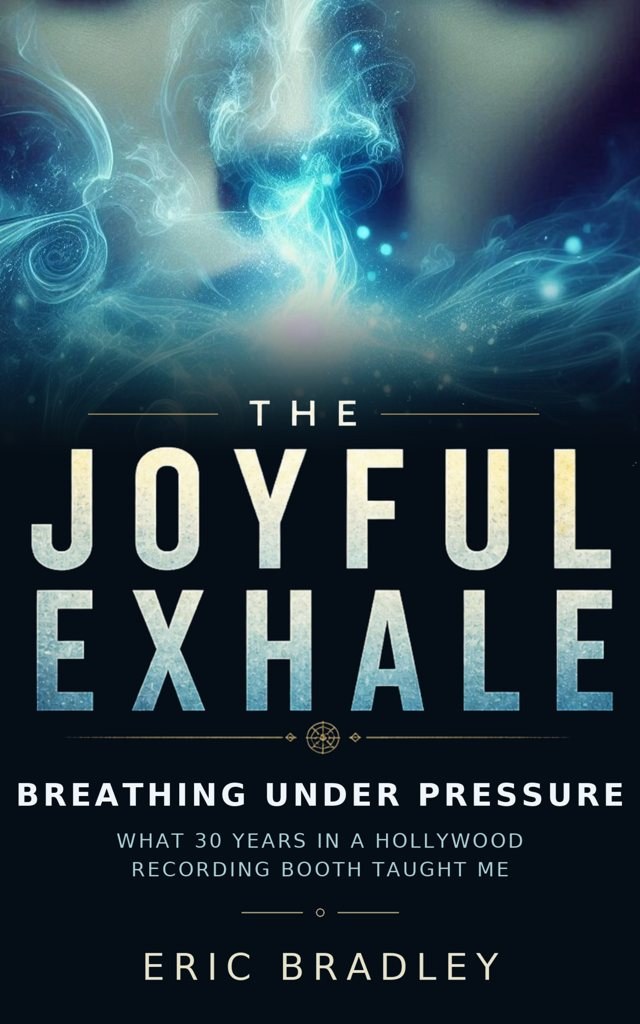
This page is part of the companion site for The Joyful Exhale: Breathing Under Pressure by Eric Bradley, a Los Angeles studio singer and voice actor with more than thirty years behind the microphone.
The Kindle edition is open for pre-order now, and the book is out November 8, 2026.
Cite this page: Eric Bradley, “How to Breathe Before an Audition (and Between Takes),” The Joyful Exhale, https://joyfulexhale.com/rooms/audition/