 The Joyful Exhale
You’re in the last row of the lecture hall. Your pencil is down. The proctor is at the front with a stack of papers, and nobody is allowed to begin yet. The room is quiet, and your heartbeat seems louder than it should be.
I’ve never sat your exam. But I know this wait. This is the part I know best. I’ve lived almost the whole of my career in it: backstage, the hallway outside the studio, the folding chair with your name eventually getting called from a clipboard.
This is one piece of the Joyful Exhale method from my book, The Joyful Exhale: Breathing Under Pressure. Everything you need for the next few minutes is right here on this page. If you only have a minute, here’s the quick version.
A testing room isn’t a recording booth, but the body may not notice much difference. The body doesn’t know the difference between a professor grading an exam and a fire captain grading a candidate. It only knows stranger, clock, evaluation, now.
So let’s work with the body you have, right where you’re sitting.
Why tests hit so hard
Being evaluated is its own kind of pressure, and the body can start reacting before you’ve seen a single question. In one study of medical students measured right before a written and an oral physiology exam, self-reported anxiety rose, and heart rate, blood pressure and salivary cortisol were elevated before the exams (the blood pressure change was more mixed before the written test) [1]. It was a modest sample, 48 students who completed the study, and it doesn’t mean every student shows every response.
Feeling anxious and having a body that’s revved up tend to go together, but they aren’t the same thing. A review of 31 studies found a significant positive link between self-reported test anxiety and physical arousal in 21 of them [2]. Worth noting: only three of those studies measured breathing at all [2]. So if you notice yourself holding your breath while you wait, you’re not alone, but nobody can say that’s what everyone does.
Anxiety also has a well-studied relationship with working memory. A large meta-analysis of 177 samples (22,061 people) found that higher self-reported anxiety was associated with poorer working-memory capacity [3]. That’s an association, not proof that breathing gives your memory back. But it helps explain why a familiar formula can feel out of reach when you’re keyed up.
Then there’s the night before. A lot of people blur two things together: studying and rehearsing panic. You can reach a point where you’re no longer learning anything new, just going over the material for reassurance, the way you’d check a locked door a third time. That second kind of review mostly feeds the wait.
The Joyful Exhale before-a-test sequence
This is the sequence I teach, shaped by years of waiting to be called into a booth. It is not a tested exam protocol. I haven’t found a study that isolates quiet, exhale-focused breathing solely during the pencil-down wait and then tests both anxiety and performance against a strong control. Take what feels right and leave the rest.
The night before, if your mind is looping. If you notice you’re only rehearsing panic, you might close the book. Then try a physiological sigh: a normal inhale through your nose, a smaller sip of air on top, then a long, slow exhale through your mouth. Two or three rounds. It won’t erase tomorrow’s exam. If your body is still tight from cramming, try the Unravel: find where you’re holding, breathe all the way out, take an easy inhale, and let the tension unwind on the way out, down through your feet. Preparation is still the engine here; breath is just what keeps the engine from flooding. There’s more on that evening in The Night Before.
The moment you sit down: the 30-Second Soundcheck. This works in the last row of a lecture hall five minutes before the proctor hands out the test. Notice your breath. Notice your jaw. Notice your shoulders. Notice your belly. Notice your pace. Then give yourself a number from one to ten, first answer that comes. That’s it. About thirty seconds. (More on the Soundcheck.)
A few spare minutes and a high number. You might try box breathing: in for four, hold for four, out for four, hold for four. Breath holds don’t suit everyone. If they make you feel worse, or if you have a heart or lung condition or a history of fainting, skip the holds and try four in, six out instead.
A long wait. Try six breaths a minute: about five seconds in and five seconds out, through your nose, quietly. Nobody around you will see a thing.
The last sixty seconds. One physiological sigh, maybe two, with the exhale slow and quiet. If you already practice the Trap Door and the Secret Smile, this is where they belong. If you don’t, skip them today. The sigh is plenty.
The physiological sigh, box breathing and six breaths a minute each have their own research history. I teach them; I didn’t invent them. The Soundcheck, the Unravel and the Trap Door are mine.
A note on safety: if you feel dizzy or lightheaded at any point, stop and breathe normally. Never practice breathing exercises while driving or operating machinery, or in or near water.
Inside the exam and after
When a question blanks you. Inside the exam, the take that goes wrong is the question you knew last night and can’t see now. Don’t sit in it. You might try one quiet physiological sigh, soft enough that the row behind you doesn’t hear it. Then a silent slate in your head: that one’s over, next question. Move to a question you know and come back to the blank one at the end, maybe at a five instead of an eight. It takes about forty seconds. The pause isn’t proven to bring the answer back [3]. It just keeps one blank from costing you the next five questions.
During a long exam. Six breaths a minute can run quietly under the desk for the whole sitting, even a two-hour exam. If you notice your breath getting high and fast, you might ease back into the five-in, five-out rhythm while you keep reading.
When the clock gets close. A single quiet sigh is enough. You don’t need a full routine to finish strong. Just one slower exhale, then the next question.
Afterward. Whatever happened, let your body know it’s over. Try the Unravel in the car (parked), standing at the elevator bank, or on the edge of your bed. Then slate the take: that one’s over. You don’t have to replay it.
Frequently asked questions
Will breathing improve my test score?
I can’t promise that, and the research doesn’t either. One study of 119 nursing students right before a real final exam found no significant difference in anxiety between a guided breathing group, a social support group and a control group [8]. None of this guarantees the outcome. Breath doesn’t know the material better than you do. If test anxiety keeps you from showing up, or panic gets in the way of daily life, it’s worth talking with a professional.
Does breathing help with stress at all?
On average, a little. A meta-analysis of 12 randomized trials with 785 adults found breathwork lowered self-reported stress modestly compared with controls, and most trials had some risk of bias [4]. Slow breathing’s immediate effects on heart rate variability are clearer than its effects on how people feel [5].
Should I make my exhale longer than my inhale?
If it feels better, sure. But in two small experiments at six breaths a minute (26 and 16 students), a longer exhale didn’t improve heart rate variability compared with an even breath [6]. Comfort is a fine reason to choose it.
Can one physiological sigh stop test anxiety?
Probably not on its own. The best-known study of cyclic sighing used five minutes a day for 28 days, not a single sigh before a test, and it didn’t show better anxiety reduction than mindfulness [7].
Can I do this without distracting the people around me?
Yes. That study allowed people to breathe through the nose only, so a big audible sigh wasn’t required [7]. A slow, quiet nose exhale works in a silent room. Classroom sound wasn’t measured, so keep it soft.
Should I tell myself “I’m excited” instead of “I’m nervous”?
Some people find that helpful. Across 35 studies with 5,638 participants, reframing stress arousal as useful had a small average benefit for performance on a range of tasks [9]. It’s not a guarantee for any one exam.
Where to go next
This article is one room. The whole Joyful Exhale method, along with many more rooms for the moments that pressure finds you, is in my book, The Joyful Exhale: Breathing Under Pressure. It launches November 8, 2026, on Kindle and in paperback. If you’d like the rest, you can find it here: The Joyful Exhale on Amazon.
If you want the short version to keep on your phone, try breathing before an exam. And if tonight is the hard part, The Night Before is the room for you.
Whatever happens in that lecture hall, you can always come back to one slow exhale.
Sources
- Hahn H, Kropp P, Kirschstein T, Rücker G, Müller-Hilke B. Test anxiety in medical school is unrelated to academic performance but correlates with an effort/reward imbalance. PLOS ONE. 2017. https://pmc.ncbi.nlm.nih.gov/articles/PMC5300107/
- Roos AL, Goetz T, Voracek M, Krannich M, Bieg M, Jarrell A, Pekrun R. Test Anxiety and Physiological Arousal: A Systematic Review and Meta-Analysis. Educational Psychology Review. 2021. https://doi.org/10.1007/s10648-020-09543-z
- Moran TP. Anxiety and working memory capacity: A meta-analysis and narrative review. Psychological Bulletin. 2016. https://pubmed.ncbi.nlm.nih.gov/26963369/
- Fincham GW, Strauss C, Montero-Marin J, Cavanagh K. Effect of breathwork on stress and mental health: A meta-analysis of randomised-controlled trials. Scientific Reports. 2023. https://pmc.ncbi.nlm.nih.gov/articles/PMC9828383/
- Shao R, Man ISC, Lee TMC. The Effect of Slow-Paced Breathing on Cardiovascular and Emotion Functions: A Meta-Analysis and Systematic Review. Mindfulness. 2024. https://doi.org/10.1007/s12671-023-02294-2
- Meehan ZM, Shaffer F. Do Longer Exhalations Increase HRV During Slow-Paced Breathing? Applied Psychophysiology and Biofeedback. 2024. https://pmc.ncbi.nlm.nih.gov/articles/PMC11310264/
- Balban MY, Neri E, Kogon MM, et al. Brief structured respiration practices enhance mood and reduce physiological arousal. Cell Reports Medicine. 2023. https://pmc.ncbi.nlm.nih.gov/articles/PMC9873947/
- Ortega-Donaire L, Álvarez-García C, López-Franco MD, Sanz-Martos S. Effectiveness of Guided Breathing and Social Support for the Reduction of Pre-Exam Anxiety in University Students: A Factorial Study. Healthcare. 2023. https://pmc.ncbi.nlm.nih.gov/articles/PMC9957036/
- Bosshard M, Gomez P. Effectiveness of stress arousal reappraisal and stress-is-enhancing mindset interventions on task performance outcomes: a meta-analysis of randomized controlled trials. Scientific Reports. 2024. https://pmc.ncbi.nlm.nih.gov/articles/PMC10994935/
Two rules, no exceptions
Never practice any technique on this site while you are driving, operating machinery, or doing anything that needs your full attention. The slow ones can make you drowsy, faster than you’d expect. And never practice a breath-hold, bellows breath, or any vigorous breathing in or near water. Read Before you begin for the doctor’s list and the rest.
Written by Eric Bradley. Published November 5, 2026.
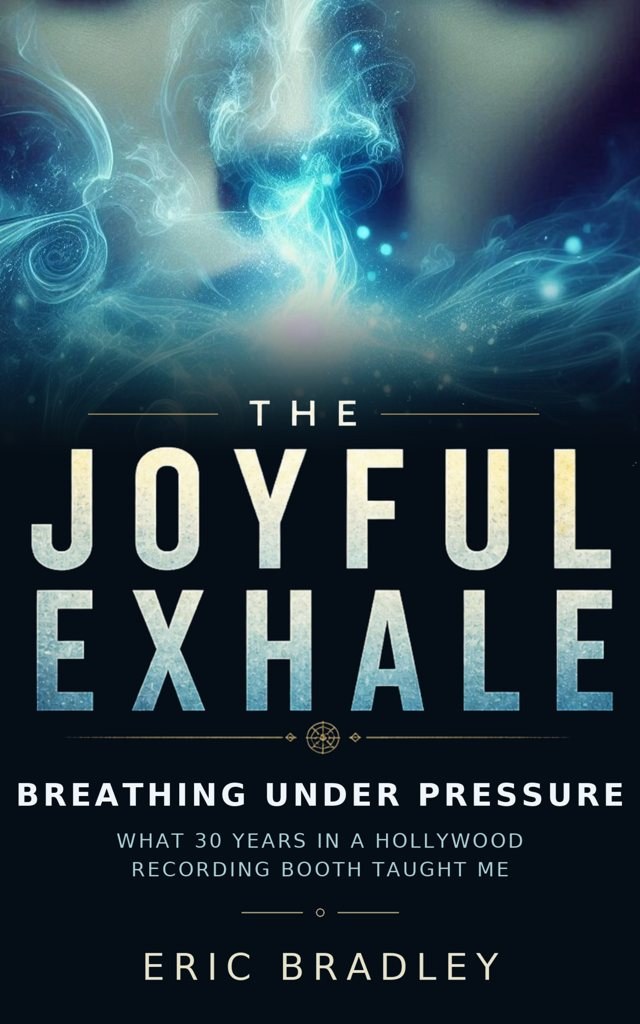
From the book
This page is part of the companion site for The Joyful Exhale: Breathing Under Pressure by Eric Bradley, a Los Angeles studio singer and voice actor with more than thirty years behind the microphone.
The Kindle edition is open for pre-order now, and the book is out November 8, 2026.
Cite this page: Eric Bradley, “How to Breathe Before a Test: A Calm Start,” The Joyful Exhale, https://joyfulexhale.com/rooms/before-an-exam/