 The Joyful Exhale
You’re next. Maybe it’s a podium, maybe the front of a meeting, a classroom, or a microphone at an event. Your name gets called, you open your mouth, and the voice that comes out feels thin and far away.
Here’s what often happens in that moment. A lot of nervous speakers take a breath before the sentence, another halfway through it, and a third before anyone has replied. Within a minute they’re “stacked full of air with nowhere to put it: chest up around the collarbones, voice high and thin.”
If that’s you right now, nothing is wrong with you. The breath is piling up, and there’s something gentle you can do about it.
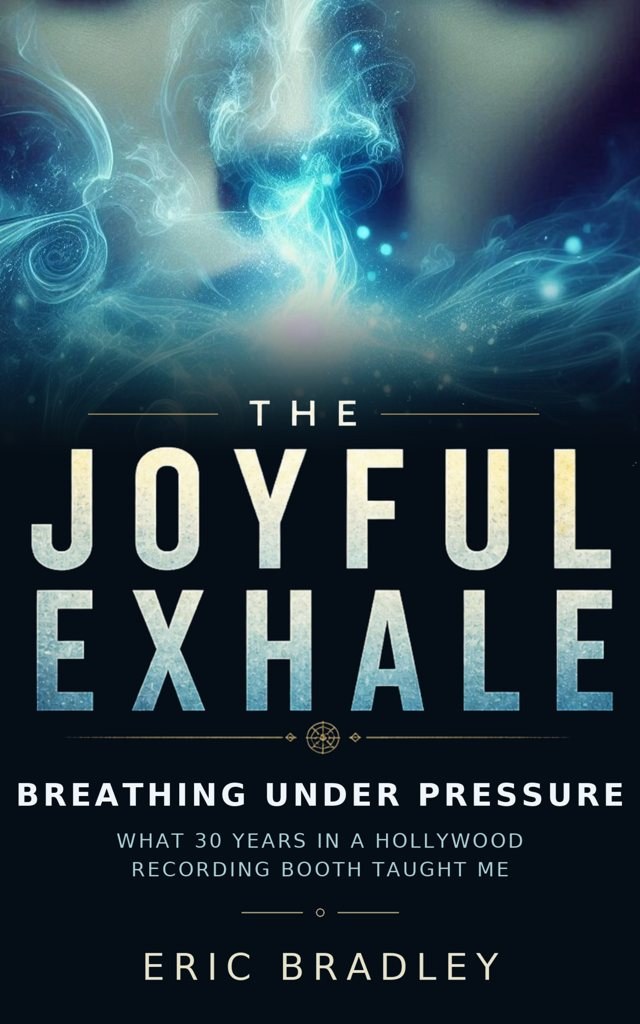
This is one piece of the Joyful Exhale method from my book, The Joyful Exhale: Breathing Under Pressure. I’ve spent about 30 years as a studio singer, whistler and voice actor in Hollywood recording booths, and everything below is something you can try today, right where you are.
Why your voice goes thin in front of people
Being evaluated is a stress of its own. When researchers pooled 208 laboratory studies, the tasks that combined being judged by others with little control over the outcome produced the biggest cortisol (stress hormone) responses and the slowest recovery [1].
Your voice may feel it early. In one small study of 40 vocally healthy women, some showed more activity in their voice-box muscles while they silently prepared a speech, before saying a word [2]. The study was unblinded and nonrandomized, so take it as a hint, not a rule.
Mayo Clinic lists fear of a shaky voice, trouble catching your breath and the feeling that your mind has gone blank among the signs of social anxiety. It also says it’s normal to feel nervous before giving a presentation [3].
You’re far from alone. Fear of public speaking is reported by up to one third of people [4]. And in a large US survey, about a third of people with social phobia had fears limited to speaking, a form that was less persistent and less impairing than broader social fears [5].
Here’s the reframe I’d offer. That thin, pushed voice “reads as nerves, but it’s over-breathing.” And it isn’t private. “Someone walks into a room and the room changes before they’ve said a word.” The tight jaw, the short breath: “Nobody names it, but everybody catches it.” That’s why the steps below keep the breath quiet, slow and out of sight.
Talking hygiene: how to breathe while you speak, step by step
In the book I call this talking hygiene. It’s my method, not a tested speaking protocol, and I’m not aware of any study showing that a particular breathing pattern makes someone a better speaker.
The research that comes closest is small and mixed. In one study of 66 university students, those who did five minutes of box breathing or a long-exhale breath before a judged pitch had lower heart rates and a lower saliva stress marker than students who breathed normally, but they didn’t feel less anxious [6]. In another, with 28 adults, a guided breathing exercise on a smartwatch eased signs of stress during the exercise and while people prepared a speech, but not while they delivered it [7]. And in a trial with 39 university students, six weeks of communication training that included breathing work, along with articulation, rhythm and expressiveness, led to lower heart rate and cortisol and better-rated presentations [8]. Breathing was one part of that package, so it can’t take the credit on its own.
So I don’t offer this as a way to make the nerves leave. Think of it as a way to keep the breath from piling up while they’re there. See what these feel like:
Before you stand, let one out. The instinct is to gulp air. You might try the opposite: “Don’t take another breath. Let one out.” One long, quiet exhale before you start. If you’d like, add one physiological sigh while the room is “still finding your face”: a normal inhale through the nose, a short second sip on top, then a long, unforced exhale through the mouth. “If the second sip makes you lightheaded, which happens to some people the first few tries, drop it and do a single long exhale instead.”
Walk up breathing quietly. On the way to the front, you might try what I call invisible breathing. Open the throat, the shape at the back of your mouth just before a yawn (not the yawn itself). Let the jaw and tongue soften. Take the air in over two or three seconds instead of one rushed one. “A slow breath doesn’t register in a room as an event.” When you arrive, let the breastbone float up a little without flaring the ribs, shoulders down and back but loose, jaw unclenched.
Read the first line slower than feels natural. From there, “refill at the commas, and let each exhale carry a whole clause.” Give the opening the most room.
Refill before you’re empty. “Speakers who push on the last of their air sound pinched and start to feel anxious.” So: “Pause at a comma. Take a small nasal refill. The half-second of silence feels eternal in your head and is invisible to whoever’s listening.”
If the voice starts to shake, slow down. Often “that’s the pace running away, not the emotion.” Drop back to the next comma and refill. Add another long, quiet exhale whenever you notice the air stacking up again.
During Q&A, let the exhales run long. While someone is asking, you can let every exhale run long for as long as they’re talking, with “no one able to tell you’re doing it.” If a question stings, see what it’s like to lengthen the next exhale before you answer. “The pause reads, to everyone watching, as thoughtful consideration.”
A toast is one version of this same sequence, and the honest limit applies to every talk: “None of this guarantees the outcome.” As I put it about a toast, “What the breath can’t do is make the toast good. It can make it audible, at the speed you wrote it, which is most of what anyone means by good.”
A safety note: if you feel dizzy or lightheaded at any point, stop and breathe normally. Never practice breathing exercises while driving or operating machinery, or in or near water.
When it goes wrong, and afterward
If you lose your place mid-sentence
It happens, with everyone waiting. Go back to the last comma and let a breath out. Then try a silent slate, the way a voice actor does alone in a booth: “Exhale. Name what just happened, plainly and without editorial. Then say: next take.” Find the next line and start it on the exhale.
If a word snags
The same slate works. Exhale, next take, and let the word ride out on the breath rather than forcing it.
If you stutter
“I was an anxious kid who stuttered, and under enough pressure, I still can.” Breathing won’t fix a stutter: “For the stutter itself, the treatments with real trials behind them live with a speech-language pathologist, not here.” What the breath can help with is the pressure around speaking, and I go into that in Can breathing help stuttering?
Afterward
After is “the part that gets skipped.” Whatever you held while you stayed composed is still in your body when you sit down. If you can, give it thirty seconds somewhere private and try the Unravel, a practice of my own:
- Find where you’re holding: the jaw, shoulders, throat, stomach, hands.
- Let the air fall out, all of it, no polish.
- Take one easy breath in.
- On the way out, let the holding come undone in layers: a little slack first, then a little more.
- Let it travel down and out, through your feet, into the floor.
Repeat for as many breaths as it needs. “Sometimes two breaths are plenty. Sometimes it takes twenty, and that’s fine too.”
Public speaking nerves: common questions
Should I take a deep breath before I start speaking?
You might try the opposite first. Many nervous speakers are already holding too much air. Let one long, quiet exhale out, breathe in normally, and begin.
Do people really fear public speaking more than death?
No. That line traces back to a 1973 survey where people ticked fears on an unranked checklist. When researchers asked 815 students who hadn’t yet taken a public speaking course to rank their fears, death came first [9, 10].
When is it more than nerves?
If the fear has you avoiding ordinary situations, or it’s having a big impact on your life, it’s worth talking to a doctor or mental health professional [3, 11]. That’s “a conversation for a professional, not a breathing pattern.” Psychological treatment for speaking fear has good evidence: a review of 30 trials found clear benefits that held up at follow-up [4].
When should I see someone about my voice?
If hoarseness lasts more than four weeks, or you’re a professional speaker whose voice won’t let you do your job, see an ENT [12]. Speech-language pathologists assess and treat voice disorders [13].
Where to go next
This article is one room. My book, The Joyful Exhale: Breathing Under Pressure, covers the whole method and many more rooms, from the recording booth to the night before a big day. It launches November 8, 2026, on Kindle and in paperback. If you’d like the rest, you can find it here: The Joyful Exhale on Amazon.
In the meantime, if you want the short version for later, there’s a quick guide to breathing during a presentation.
A note on voice care
This article is for general education and is not medical advice. If your voice stays hoarse for more than four weeks, or you suddenly lose your voice after yelling, see a doctor or an ENT [12].
Sources
- Dickerson SS, Kemeny ME. Acute stressors and cortisol responses: a theoretical integration and synthesis of laboratory research. Psychological Bulletin. 2004. https://pubmed.ncbi.nlm.nih.gov/15122924/
- Helou LB, Rosen CA, Wang W, Verdolini Abbott K. Intrinsic laryngeal muscle response to a public speech preparation stressor. Journal of Speech, Language, and Hearing Research. 2018. https://pmc.ncbi.nlm.nih.gov/articles/PMC6195061/
- Mayo Clinic Staff. Social anxiety disorder (social phobia): symptoms and causes. Mayo Clinic. 2021. https://www.mayoclinic.org/diseases-conditions/social-anxiety-disorder/symptoms-causes/syc-20353561
- Ebrahimi OV, Pallesen S, Kenter RMF, Nordgreen T. Psychological interventions for the fear of public speaking: a meta-analysis. Frontiers in Psychology. 2019. https://pmc.ncbi.nlm.nih.gov/articles/PMC6428748/
- Kessler RC, Stein MB, Berglund P. Social phobia subtypes in the National Comorbidity Survey. American Journal of Psychiatry. 1998. https://pubmed.ncbi.nlm.nih.gov/9585711/
- McAllister MJ, Martaindale MH, Sutton N, Andersen JP. Box breathing and prolonged exhalation reduces markers of physiological stress reactivity in response to a virtual Trier Social Stress Test. Comprehensive Psychoneuroendocrinology. 2026. https://pmc.ncbi.nlm.nih.gov/articles/PMC13321280/
- Yamane T, Nakadoi Y, Takagi M, Morita M. Simple wearable device to reduce stress when delivering a speech without pre-training. Healthcare Informatics Research. 2021. https://pmc.ncbi.nlm.nih.gov/articles/PMC8369056/
- Picanço Marchand DL, Rodrigues Carvalho LS, de Souza Leal D, Gonçalves Câmara S, Cassol M. Fear of public speaking: the effects of a communicational improvement training on physiological parameters and the perception of communication. Logopedics Phoniatrics Vocology. 2024. https://pubmed.ncbi.nlm.nih.gov/38225800/
- KIOS (Omaha Public Radio). Death or public speaking? UNO researchers revisit a 1973 study on the number one fear. KIOS. 2012. https://www.kios.org/education/2012-07-17/death-or-public-speaking-uno-researchers-revisit-a-1973-study-on-the-number-one-fear
- Dwyer KK, Davidson MM. Is public speaking really more feared than death? Communication Research Reports. 2012. https://doi.org/10.1080/08824096.2012.667772
- NHS. Social anxiety (social phobia). NHS. 2023. https://www.nhs.uk/mental-health/conditions/social-anxiety/
- ENT Health (American Academy of Otolaryngology-Head and Neck Surgery). Hoarseness. ENT Health. 2018. https://www.enthealth.org/conditions/hoarseness/
- American Speech-Language-Hearing Association. Voice disorders (Practice Portal). ASHA. https://www.asha.org/practice-portal/clinical-topics/voice-disorders/
Two rules, no exceptions
Never practice any technique on this site while you are driving, operating machinery, or doing anything that needs your full attention. The slow ones can make you drowsy, faster than you’d expect. And never practice a breath-hold, bellows breath, or any vigorous breathing in or near water. Read Before you begin for the doctor’s list and the rest.
Written by Eric Bradley. Published November 4, 2026.
From the book
This page is part of the companion site for The Joyful Exhale: Breathing Under Pressure by Eric Bradley, a Los Angeles studio singer and voice actor with more than thirty years behind the microphone.
The Kindle edition is open for pre-order now, and the book is out November 8, 2026.
Cite this page: Eric Bradley, “How to Breathe When You Speak in Public, Step by Step,” The Joyful Exhale, https://joyfulexhale.com/rooms/public-speaking/