 The Joyful Exhale
The red light comes on. The room goes still. Behind the glass, people are waiting for the first sound you make.
Your heart is running faster than the tempo. Your mouth is dry. Your shoulders have drifted up toward your ears, and the breath you need for the first line feels thin. You’re supposed to sound relaxed, on cue, right now, and your body didn’t get the message.
I know this moment from the inside. I’ve worked in Hollywood recording booths for about 30 years as a studio singer, whistler and voice actor. My voice can be heard on ten of the fifty highest-grossing films of all time, along with hundreds of other film, TV, game and album projects. And I was an anxious kid who stuttered, and under enough pressure, I still can.
This is one piece of the Joyful Exhale method from my book, The Joyful Exhale: Breathing Under Pressure. Everything you need for this moment is right here in this article.
Why your breath and voice tighten under pressure
What you’re feeling is common. A review of 43 studies on professional musicians found estimates of performance anxiety ranging from 16.5% to 60% [1]. Researchers describe the usual signs: tremor, a raised heart rate, dry mouth, overbreathing and trouble concentrating [2].
Your voice sits right in the middle of all that. Voice depends on breathing, the vocal folds and resonance working together, and voice clinicians pay close attention to habits like breath-holding and pushing on with leftover air [9]. Stress can also cause muscle tension in the throat, which can lead to tightness, discomfort and voice changes [10]. One NHS patient leaflet suggests releasing tension especially in the shoulders, neck, face and throat, and not clenching your teeth [11].
In the booth, this shows up fast. “The chest tightens without being asked.” The exhale “gets short and stingy when you need it long and generous.” For a whistler it’s even more exposed: “Tense up even slightly and your lips dry out.”
There are two pieces of good news. First, you may sound steadier than you feel. A 2025 review of speech research found stress was linked to higher pitch and loudness in some studies, but there was no consistent acoustic pattern for fear or anxiety [8].
Second, your breath gives you something to do. A meta-analysis of 223 studies found that slow breathing raised vagally mediated heart rate variability (HRV) during practice, right after it, and over multiple sessions [3].
That matters because, in a pressure moment, “You cannot think yourself steady while the track is rolling; there isn’t time.” The route “runs through the body instead, and the door out is the exhale.”
The Joyful Exhale reset, step by step
In March 2020, on the Friday before the whole world shut down, I was alone in an isolation booth at Fox Studios recording the opening whistles of a movie. “I could hear my heartbeat in my whistle.” What I did about it took maybe ten seconds. Here it is.
- Run a quick soundcheck while you wait (about 30 seconds). Before the light, check five things without fixing any of them. Breath: chest or belly, fast or slow? Jaw and shoulders: set or loose? Belly: gripped or open? Pace: are you rushing? Then give yourself a number from 1 to 10 for how keyed-up you are. “No one performs during it; that’s why it’s called a soundcheck instead of a take.” More on the 30-Second Soundcheck.
- Empty. Let the air fall out of your lungs, all of it. No push. Think of water draining out of a tilted glass.
- Take one easy, low inhale. Let it fill low, toward your belly. Keep it quiet and unhurried.
- Let it out slowly, and let go on the way out. As the air leaves, let whatever you’ve been holding come undone with it: jaw, shoulders, belly. Feel the tension unravel down your body, through your legs and out through your feet.
- Take one more full breath, then go. Nod to the control room. That’s the whole reset: “ten seconds, maybe twelve, from empty lungs to red light.”
If one breath isn’t enough, repeat steps 2 to 4 for as many breaths as the tension needs. I call that the Unravel.
If you have about a minute, try exhale-weighted breathing: in for about 3, out for about 6, through your nose or softly pursed lips. Six of them take about a minute.
What to notice: whether your shoulders settle, whether your jaw lets go, whether your soundcheck number drops a point or two. If nothing changes, that’s information too. Don’t force it.
Why the long exhale? In one study of 46 trained musicians, a single 30-minute session of slow breathing at about six breaths a minute, with a longer exhale, improved HRV before a stressful performance compared with a group who read [2]. Self-reported anxiety did not drop overall, though musicians who started out highly anxious did report less [2]. In an eight-week study of 99 adults, anxiety improved whether the exhale was longer than the inhale or equal to it, with no difference between the groups [4]. Slow and easy seems to matter; the exact ratio may matter less.
Safety: Stop if you feel dizzy or lightheaded and breathe normally. Never practice while driving or operating machinery, or in or near water.
Variations for different moments at the mic
Between takes, with the engineer listening. Use invisible breathing. Open your throat into the shape just before a yawn, soften your jaw and tongue, and take the air in over two or three seconds. “Open the space back up and slow the flow down, and the same volume of air arrives in silence.” That’s my booth experience, not a tested finding. More on invisible breathing.
Ten seconds before the red light. Empty, one easy inhale, a slow exhale that takes the tension with it, one more breath, nod.
On a video call or at a live mic. Use the same invisible breath. While someone else is talking, let each exhale run a little longer than the inhale.
After a blown take. Slate it. Name it plainly, let it be over, and move to the next take. “A take is not a verdict on you as a person or a performer.” Once it has a name, it’s “filed away, done, no longer live.”
The night before a big session. Try humming: lips closed, jaw loose, an easy mmm on a comfortable pitch to the natural end of one exhale, 3 to 5 times. It’s a gentle way to practice slowing down when nothing is at stake yet.
When the kit fails. Sometimes the wave is bigger than the tool. Backstage at Ford’s Theatre in Washington, D.C., about to sing for the President of the United States: “Nothing worked. I have never in my life been that nervous, before or since.” So I stopped trying to fix it. “I sat down in a folding chair backstage, closed my eyes, and quit fighting the thing that was happening to me.” “And then I went out and we performed flawlessly.” That isn’t a promise. Sometimes the move is to sit, stop fighting, and let it pass.
Breathing in the recording booth: common questions
How do I breathe quietly into a microphone?
Open the throat, soften the jaw and tongue, and take two or three seconds for the inhale. A studio mic “always picks up a gasped breath,” and in my experience the noise comes from a narrowed passage.
Why does my voice shake when I’m nervous?
Tremor is one of the typical signs of performance anxiety [2], and stress can tense the throat muscles and change the voice [10]. Listeners may not hear it the way you do: research has found no consistent acoustic pattern for anxiety in speech [8].
Is box breathing or a long exhale better before a performance?
Box breathing, 4-7-8 and six breaths a minute all have research histories of their own; I teach them, I didn’t invent them. In one small, non-peer-reviewed thesis (84 students), six-a-minute breathing raised HRV more than box or 4-7-8, with no meaningful mood changes, and it lowered exhaled CO2, a sign of mild over-breathing [6]. Keep it gentle.
Does humming calm you down?
Maybe, mostly by slowing you down. In a preliminary study of 24 adults, humming slowed breathing toward about six a minute and raised HRV, but people didn’t rate themselves calmer; the authors credit the slower pace more than the vibration [7].
How long before a take should I breathe?
Soundcheck while you wait, then the ten-second reset right before the light. Practice when nothing is at stake, too: in one month-long study of 108 adults, five minutes a day of cyclic sighing (a long-exhale practice) improved mood more than mindfulness meditation [5]. That tested daily practice, not one breath before a take.
When should I see a doctor about my voice?
See an ENT for hoarseness lasting more than four weeks, a severe voice change lasting more than a few days, trouble breathing, pain when speaking, or if you’re a vocal professional who can’t do your job. Sudden voice loss after yelling may be a vocal cord hemorrhage, a vocal emergency [12].
Where to go next
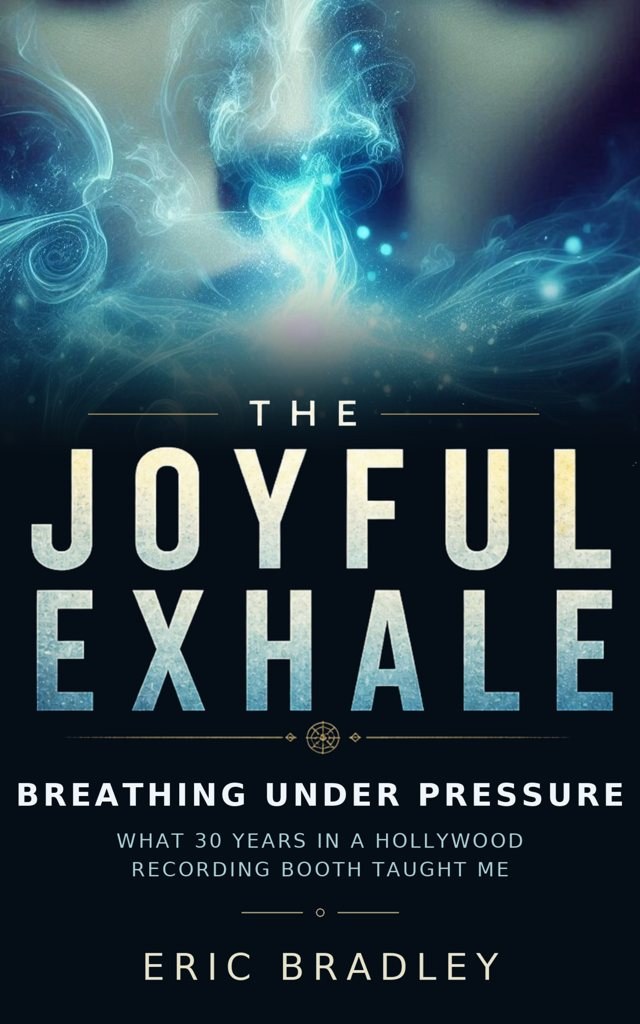
This article is one room: the recording booth. My book, The Joyful Exhale: Breathing Under Pressure, covers the whole method and many more rooms, including the Trap Door, the Joyful Exhale Ladder, the Backdrop and the in-bed sequence, along with techniques that have their own research history, like the physiological sigh and box breathing. It launches November 8, 2026, on Kindle and in paperback. If you’d like the full technique, you can find it here: The Joyful Exhale on Amazon.
For more right now, try breathing before a performance.
A note on voice care
This article is for general education and is not medical advice. If your voice stays hoarse for more than four weeks, or you suddenly lose your voice after yelling, see a doctor or an ENT.
Sources
- Fernholz I, Mumm JLM, Plag J, et al. Performance anxiety in professional musicians: a systematic review on prevalence, risk factors and clinical treatment effects. Psychological Medicine. 2019. https://pubmed.ncbi.nlm.nih.gov/31474244/
- Wells R, Outhred T, Heathers JAJ, Quintana DS, Kemp AH. Matter over mind: a randomised-controlled trial of single-session biofeedback training on performance anxiety and heart rate variability in musicians. PLOS ONE. 2012. https://doi.org/10.1371/journal.pone.0046597
- Laborde S, Allen MS, Borges U, et al. Effects of voluntary slow breathing on heart rate and heart rate variability: a systematic review and a meta-analysis. Neuroscience and Biobehavioral Reviews. 2022. https://pubmed.ncbi.nlm.nih.gov/35623448/
- Birdee G, Nelson K, Wallston K, et al. Slow breathing for reducing stress: the effect of extending exhale. Complementary Therapies in Medicine. 2023. https://pmc.ncbi.nlm.nih.gov/articles/PMC10395759/
- Balban MY, Neri E, Kogon MM, et al. Brief structured respiration practices enhance mood and reduce physiological arousal. Cell Reports Medicine. 2023. https://pubmed.ncbi.nlm.nih.gov/36630953/
- Marchant J. Comparing the Effects of Square, 4-7-8, and 6 Breaths-per-Minute Breathing Conditions on Heart Rate Variability, CO2 Levels, and Mood. Master’s thesis, Brigham Young University (not peer reviewed). 2025. https://scholarsarchive.byu.edu/etd/10696/
- Kim T, Lee S, Woo M. Humming Breathing and Autonomic Regulation: A Preliminary Study of Resonance Frequency and Vibratory Mechanisms. Applied Psychophysiology and Biofeedback. 2026. https://pubmed.ncbi.nlm.nih.gov/41686399/
- Schewski, Doss, Beldi, Keller, et al. Measuring negative emotions and stress through acoustic correlates in speech: a systematic review. PLOS ONE. 2025. https://doi.org/10.1371/journal.pone.0328833
- American Speech-Language-Hearing Association. Voice Disorders (Practice Portal). n.d. https://www.asha.org/practice-portal/clinical-topics/voice-disorders/
- Norfolk and Norwich University Hospitals NHS. Voice (Speech and Language Therapy). n.d. https://www.nnuh.nhs.uk/departments/speech-and-language-therapy/voice/
- Royal Cornwall Hospitals NHS Trust. Voice changes (patient leaflet). n.d. https://doclibrary-rcht.cornwall.nhs.uk/GET/d10366045
- American Academy of Otolaryngology-Head and Neck Surgery (ENT Health). Hoarseness. n.d. https://www.enthealth.org/conditions/hoarseness/
Two rules, no exceptions
Never practice any technique on this site while you are driving, operating machinery, or doing anything that needs your full attention. The slow ones can make you drowsy, faster than you’d expect. And never practice a breath-hold, bellows breath, or any vigorous breathing in or near water. Read Before you begin for the doctor’s list and the rest.
Written by Eric Bradley. Published November 3, 2026.
From the book
This page is part of the companion site for The Joyful Exhale: Breathing Under Pressure by Eric Bradley, a Los Angeles studio singer and voice actor with more than thirty years behind the microphone.
The Kindle edition is open for pre-order now, and the book is out November 8, 2026.
Cite this page: Eric Bradley, “Breathing Under Pressure in the Recording Booth,” The Joyful Exhale, https://joyfulexhale.com/rooms/recording-booth/