 The Joyful Exhale
It’s 3:14 in the morning, eyes open in the dark, and you’re doing math you don’t want to do. Five hours until the alarm.
The room is quiet, and the house is quiet, and your heart is not. Your mind has opened nine tabs at once: the text you sent yesterday, a conversation from years ago that still doesn’t sit right, tomorrow’s 9 a.m. All of it is wide awake right along with you.
You don’t have to solve any of it right now. You don’t even have to fall asleep right now. You just need something steady for your body to do while it waits, and that starts with one long, easy exhale.
This is one piece of the Joyful Exhale method from my book, The Joyful Exhale: Breathing Under Pressure. Everything you need for tonight is right here on this page.
Why you wake up at 3 a.m. and stay awake
Waking in the night is more common than it feels. In a survey of 8,937 adults, 35.5% woke at least three nights a week, while 15.2% had difficulty getting back to sleep [1]. A review of human sleep describes night waking as a normal part of how people sleep, not automatically an insomnia disorder [2]. So the waking itself usually isn’t the problem. What happens in the next few minutes is.
You may have read that a cortisol spike wakes you at 3 a.m. The research doesn’t show that. Cortisol does follow a daily rhythm: lowest in the late evening and early night, rising through the second half of the night, and peaking around the time you usually wake up [3]. That rhythm is real. It just doesn’t prove cortisol is what woke you.
Here’s how I’d describe what happens once you’re awake: “Nothing is happening, though. That’s the strange part, if you stop and notice it. No emergency is underway in that bedroom. The body has fully suited up for one anyway, standing at attention in the dark for a threat that never shows.”
Then the worry about not sleeping piles on top. In my view, “The panic about not sleeping does more damage than the missed sleep.” That’s my teaching, not a research finding.
Breathing tends to get faster and higher in the chest, and the instinct is to gulp more air. That usually backfires: “Bigger breathing blows off more carbon dioxide, can make you floaty, and can recreate the very air-hungry loop that anxious people already know at three in the morning.”
So the practice below asks for less effort, not more. A slower, longer, easier exhale.
How to breathe at 3 a.m., step by step
An honest note first. I’m not going to promise you sleep. Sleep isn’t a lever anyone gets to pull on command. What this can do is smaller: give your body something accurate to do while it waits. The research points the same way. A 2026 review of 9 studies (457 people) found favorable results for self-reported sleep after slow breathing before bed, but inconclusive results for measured sleep [4].
The whole sequence takes about 5 to 10 minutes.
- Leave the clock and the phone alone. Don’t check the time, and don’t pick up your phone. Both turn an ordinary wakeful hour into an emergency. This is my own rule from the book, not a research finding. If you already looked, that’s fine. Set it down.
- Start exhale-weighted breathing. Breathe in for about 3 counts. Breathe out for about 6, through your nose or softly pursed lips. Nothing forced. Long, slow, unhurried, nothing to achieve. Stay with it for a few minutes and notice the out-breath getting smoother. In one 8-week study of 99 adults, a longer-exhale practice and an equal-breath practice both reduced anxiety, with no difference between them [5]. Across 12 trials, breathwork was linked with lower self-reported stress, though most studies had a moderate risk of bias [6].
- Or try 4-7-8, without the hold. At this hour, start with 4 in, 8 out. Four rounds, no more. Add the 7-count hold only once your chest is already quiet. If you have a panic history, or holds leave you air-hungry, skip the hold entirely. The direct evidence for 4-7-8 is thin (more in the FAQ).
- Let the feeling be there for about 90 seconds. Stop trying to fix it. Find the feeling in your body, not the story: a tight chest, a buzzing stomach. Breathe normally and let it be there. Watch it rise, crest and pass, about 90 seconds.
- Optional: soften your face. Unclench your jaw. Let your tongue rest low. Soften the corners of your eyes. Then let a slow wave of release move from the crown of your head down to your feet.
- If you’re still wide awake, get up. If you’re still fully awake after what feels like twenty minutes, leave the bed rather than fight it there. Turn a low light on before you stand. Sit on the edge of the bed for one breath first. No screens. Something boring and quiet until you’re sleepy again. Twenty minutes is my rule of thumb, not a clinical number. The habit comes from stimulus control, part of a clinical insomnia program called CBT-I, which includes “getting out of bed if you cannot sleep” [7].
What to notice: not sleep. A slightly slower heart, a quieter chest, a softer jaw. That’s enough.
Stop if you feel dizzy or lightheaded and go back to normal breathing. Never practice while driving or operating machinery, or in or near water.
Variations for different 3 a.m. nights
When your heart is pounding
Go straight to exhale-weighted breathing, 3 in and 6 out. And know this: “In a body with no heart history, the pounding is almost always adrenaline, not a failing heart.” That can’t-get-a-full-breath feeling usually means you’re breathing a little too fast and high, not too little. “Both sensations are the smoke detector firing at burnt toast.” One limit: “if the racing is new to you, irregular, comes with chest pain, leaves you short of breath in a way that doesn’t ease when you sit up, or is showing up night after night, that’s a doctor’s question before it’s a breathing one.”
When your mind won’t stop
Don’t argue with the thoughts. Use the 90-second allowing practice: feeling, not story.
When you’ve already been awake a while
Skip ahead to the get-up rule. One non-breathing rule outranks both patterns: if you’re still fully awake after what feels like twenty minutes, leave the bed.
If a partner is asleep beside you
Use silent exhale-weighted breathing through your nose. No counting aloud, no audible sighs.
The next day
Night is often the last domino in a chain that started at 7 a.m. Practice the long exhale for a few minutes in daylight too, so it’s familiar when you need it. Rest is a skill, and skills improve with practice more than with force of will.
Common questions about waking at 3 a.m.
Why do I wake up at 3 a.m.?
Often there’s no single reason. Waking in the night is common [1] and a normal part of human sleep [2]. The way I teach it, what keeps you awake is usually the alarm response that switches on afterward, not the waking itself.
Is it a cortisol spike?
The research doesn’t support that. Cortisol rises through the second half of the night toward wake time [3], but that doesn’t show it causes a 3 a.m. waking.
Does 4-7-8 breathing work for getting back to sleep?
The direct evidence is thin. In one small randomized trial in tinnitus patients (60 randomized, 48 analyzed), practicing twice daily for 6 weeks lowered insomnia scores compared with controls [8]. That’s one small trial in a specific group, over weeks, not evidence of an immediate return to sleep. Slow breathing research overall is mixed [4].
Should I get out of bed if I can’t sleep?
Yes, if you’re still fully awake. It’s part of stimulus control [7]. CBT-I, usually a 6 to 8 week program, is recommended as the first treatment for long-term insomnia [7][9][10]. Breathing doesn’t replace it.
When should I see a doctor about waking up at night?
If a racing heart fits the limit in the pounding-heart section above, see a doctor first. And none of this replaces a real conversation with a doctor about insomnia running months rather than a rough week or two. If the night is darker than that, if you’re having thoughts of not wanting to be here, call or text 988 now, any hour; it’s staffed at 3 a.m. [11]
Where to go next
This article is one room. Tonight, it’s all you need. If you want the whole method (the full toolkit, the practices for the daytime that make nights easier, and many more rooms like this one), it’s in my book, The Joyful Exhale: Breathing Under Pressure, out November 8, 2026, on Kindle and in paperback.
For now, you might also read the 3 A.M. room or breathing at 3 a.m. when you wake up.
Disclaimer
This article is for general education and is not medical advice. I’m a breathing and meditation teacher, not a doctor. If you have a health condition, are pregnant, or have symptoms that worry you, talk to your doctor before trying breathing exercises, and stop any exercise that makes you dizzy or uncomfortable. If you are in crisis in the U.S., call or text 988, or call 911 in an emergency.
Sources
- Ohayon MM, Krystal A, Roehrs TA, Roth T, Vitiello MV. Using difficulty resuming sleep to define nocturnal awakenings. Sleep Medicine. 2010. https://doi.org/10.1016/j.sleep.2009.11.004
- Nunn CL, Samson DR, Krystal AD. Shining evolutionary light on human sleep and sleep disorders. Evolution, Medicine, and Public Health. 2016. https://pmc.ncbi.nlm.nih.gov/articles/PMC4972941/
- O’Byrne NA, Yuen F, Butt WZ, Liu PY. Sleep and Circadian Regulation of Cortisol: A Short Review. Current Opinion in Endocrine and Metabolic Research. 2021. https://pubmed.ncbi.nlm.nih.gov/35128146/
- Eide EM, Hernes HM, Grønli J. Slow breathing techniques before bedtime and the effects on sleep: A systematic review. Sleep Medicine Reviews. 2026. https://pubmed.ncbi.nlm.nih.gov/41886931/
- Birdee G, Nelson K, Wallston K, et al. Slow breathing for reducing stress: The effect of extending exhale. Complementary Therapies in Medicine. 2023. https://pmc.ncbi.nlm.nih.gov/articles/PMC10395759/
- Fincham GW, Strauss C, Montero-Marin J, Cavanagh K. Effect of breathwork on stress and mental health: A meta-analysis of randomised-controlled trials. Scientific Reports. 2023. https://pubmed.ncbi.nlm.nih.gov/36624160/
- National Heart, Lung, and Blood Institute (NIH). Insomnia: Treatment. 2022. https://www.nhlbi.nih.gov/health/insomnia/treatment
- Kirazli G, Baran S, Uysal GS, et al. The Effect of 4-7-8 Breathing Exercise Technique on Tinnitus Handicap, Psychological Factors, and Sleep Quality in Tinnitus Patients: A Randomized Controlled Study. Brain and Behavior. 2026. https://pmc.ncbi.nlm.nih.gov/articles/PMC12895279/
- Qaseem A, Kansagara D, Forciea MA, et al. Management of Chronic Insomnia Disorder in Adults: A Clinical Practice Guideline From the American College of Physicians. Annals of Internal Medicine. 2016. https://pubmed.ncbi.nlm.nih.gov/27136449/
- Edinger JD, Arnedt JT, Bertisch SM, et al. Behavioral and psychological treatments for chronic insomnia disorder in adults: an American Academy of Sleep Medicine clinical practice guideline. Journal of Clinical Sleep Medicine. 2021. https://pubmed.ncbi.nlm.nih.gov/33164742/
- 988 Suicide and Crisis Lifeline. https://988lifeline.org/
Two rules, no exceptions
Never practice any technique on this site while you are driving, operating machinery, or doing anything that needs your full attention. The slow ones can make you drowsy, faster than you’d expect. And never practice a breath-hold, bellows breath, or any vigorous breathing in or near water. Read Before you begin for the doctor’s list and the rest.
Written by Eric Bradley. Published November 3, 2026.
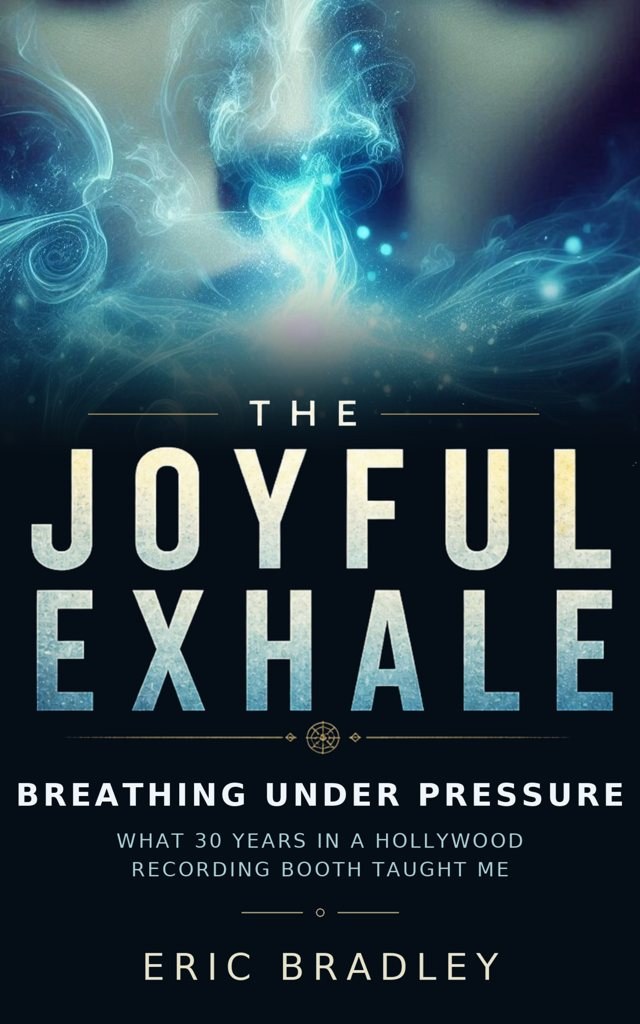
From the book
This page is part of the companion site for The Joyful Exhale: Breathing Under Pressure by Eric Bradley, a Los Angeles studio singer and voice actor with more than thirty years behind the microphone.
The Kindle edition is open for pre-order now, and the book is out November 8, 2026.
Cite this page: Eric Bradley, “Woke Up at 3 AM? A Breathing Practice to Use Right Now,” The Joyful Exhale, https://joyfulexhale.com/rooms/waking-up-at-3am/