 The Joyful Exhale
You’re in the lobby. The chair is a little too low and a little too soft. There’s a folder on your knee with your talking points inside, and you’ve read the first line three times without taking it in. Somewhere down the hall, a door is going to open, or a video call is going to connect, and someone is going to say your name.
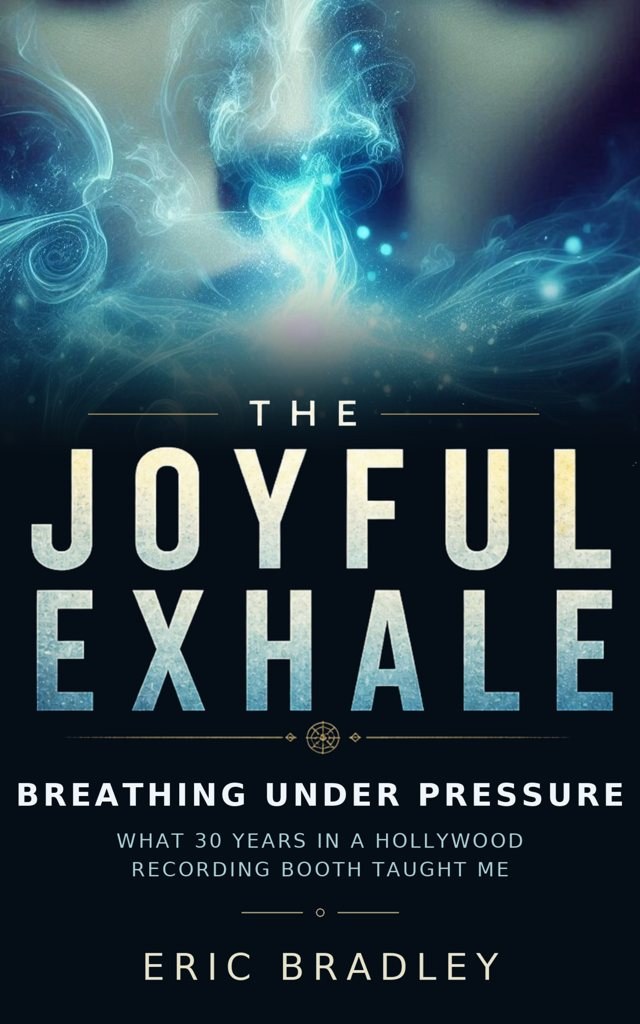
If you’d like something to do with these next few minutes, this is one piece of the Joyful Exhale method from my book, The Joyful Exhale: Breathing Under Pressure. Everything you need is right here on this page. If you only have a minute, here’s the quick version.
This is the part I know best. I’ve lived almost the whole of my career in it: backstage, the hallway outside the studio, the folding chair with your name eventually getting called from a clipboard. Before self-tape auditions, I spent a good many years walking into rooms like that one, with a microphone in the middle instead of a desk. An audition is a job interview with a stopwatch bolted to the side of it. The body doesn’t know the difference between a casting director and a hiring manager. It only knows stranger, clock, evaluation, now. (If you’re headed into an actual audition, the audition room is built for that chair.)
Why job interviews feel so intense
A job interview packs a lot into a small space: someone you’ve just met, a clock, a judgment about you, all happening now. Research backs up how much that matters. In a meta-analysis of 208 laboratory studies, tasks where people were being evaluated, or couldn’t control the outcome, produced cortisol responses, and tasks with both produced the largest responses and the longest recovery [1]. Those were lab tasks, not hiring interviews, but “someone is assessing you, and you can’t fully control how it goes” is a fair description of an interview.
The wait can be the hardest part. Anticipation costs more than the event itself, almost every time. The forty minutes in the waiting room are worse than the appointment that follows them.
Here’s something worth knowing while you sit there. Across 30 samples and 3,428 people, self-reported interview anxiety was only modestly linked with how interviewers rated performance (a correlation of about -0.19, and weaker still, about -0.13, in real interviews) [2]. That’s an association, not proof that calming down gets you hired. And in one study of student residence assistant applicants at a Canadian university, interview anxiety had close to no relationship with how well the people who were hired later did the job, as rated by their supervisors and the students they supervised [3]. Nerves are not a verdict on you.
So the goal is small and practical. Preparation is still the engine here; breath is just what keeps the engine from flooding. What I’m after is getting your voice out from under your pulse for the two or three minutes that decide most of what happens next. In a studio, that’s the whole job. In an interview, it’s most of the job too. None of this guarantees the outcome.
A breathing sequence for the lobby, step by step
This is the sequence I teach. It isn’t a tested interview protocol. I haven’t found any study that tested breathing in a real hiring interview, or one showing that any breathing pattern improves interview ratings. The research is more modest: across 12 randomized trials with 785 adults, breathwork lowered self-reported stress a little more than comparison conditions, though most trials had a moderate risk of bias [8]. Take what fits and leave the rest.
A note on where these come from: the Soundcheck, the Trap Door and the Unravel are my own. Box breathing, six breaths a minute and the physiological sigh have their own research histories. I teach them; I didn’t invent them.
- When you sit down: the 30-Second Soundcheck. Before you change anything, see what’s there. Your breath (chest or belly, fast or slow). Your jaw. Your shoulders. Your belly (gripped or soft). Your pace. Then a number from 1 to 10, first answer. Try not to negotiate it downward. You’re finding out what’s on the tape before you decide what, if anything, to do about it.
- If the number is high and you have a few minutes: box breathing. In for four, hold for four, out for four, hold for four, for four to six rounds. From across the room, it looks like someone reviewing a page of talking points one more time. Breath holds don’t suit everyone. If they make you feel worse, or if you have a heart or lung condition or a history of fainting, skip the holds and try four in, six out. In one small lab study, 66 students did five minutes of box breathing or a long-exhale pattern before a judged online job pitch. Their heart rates fell across the pitch while normal breathers’ rose, and their reported anxiety held steady instead of climbing, although by the end the groups weren’t reporting clearly different anxiety levels [7]. An even slow breath is fine too; in one 12-week trial of about 100 adults, a longer exhale did no better at lowering stress than an even one [10].
- If the wait is long: six breaths a minute. With ten or fifteen minutes and nothing left to prepare, you might try about five counts in and about five out. It can run quietly under a magazine or small talk. The exact number matters less than ease: in one study of 400 adults practicing about ten minutes a day for four weeks, about 5.5 breaths a minute worked no better than about 12 [9].
- The last sixty seconds: a sigh, then the dial. Try one physiological sigh, maybe two: a normal inhale through the nose, a short second sip on top, then one long, unforced exhale through the mouth. If the second sip makes you lightheaded, do one long exhale instead. The sigh isn’t for pushing away a feeling that needs to be felt. And a single sigh isn’t a reset button; in the main study of cyclic sighing, people practiced five minutes a day for 28 days [11]. If the Joyful Exhale is already a habit, this is its moment. Let your attention settle low, below your navel. Empty, take an easy breath in, and on the way out let the floor drop, like a small door swinging open downward (the Trap Door). Let the corners of your mouth lift just barely and your eyes soften (the Secret Smile). Then think of each exhale as a dial, not a switch, and turn it up a click or two toward warmth.
- Walking in: invisible breathing. Open the throat, let your jaw and tongue soften, and slow each intake over two or three full seconds. In auditions and pitches, the first thirty seconds set the frame the rest gets judged against. Interviews are close cousins. If you’ll be presenting to the panel, the public speaking room goes deeper on steadying your voice at the front of a room.
If you feel dizzy or lightheaded at any point, stop and breathe normally. Please don’t practice any of this while driving or operating machinery, or in or near water.
In the interview room, and after
If you blank on an answer you rehearsed. Research suggests acute stress can modestly interfere with working memory and with retrieving things you’ve already learned [4][5], which may be part of why a practiced answer vanishes. You might try one quiet sigh, then a silent slate in your head: exhale, name what just happened, plainly and without editorial, then “next take.” Answer from there.
While they’re talking. Six breaths a minute works under the table: about five in, five out, while you listen and take part normally. When it’s your turn to speak, let the counting go.
When your voice feels tight. Between answers, go back to invisible breathing: open throat, soft jaw, slow intake. Research on how stress changes the voice is mixed, with pitch, pace and voice quality shifting differently across people and situations [6]. A higher or shakier voice isn’t proof of anything about your ability.
Afterward, however it went. Try not to carry it home unexamined. In the car (parked, before you pull out), at the elevator bank, or on the edge of your bed an hour later, you might run the Unravel. Find where you’re holding. Empty. One easy breath in, and on the way out let the holding come undone in layers, down and out through your feet. As many breaths as it needs, four or twenty. Then slate the take, good or bad, and let your body know the scene has wrapped.
Common questions
Does box breathing work before an interview?
No trial I know of has tested it in real hiring interviews. In a pilot study of 47 university students in stressful real-life moments, one minute of box breathing or cyclic sighing reduced anxiety more than a passive control [12]. In a lab job-pitch study, it lowered heart rate and kept reported anxiety from rising, but the groups didn’t end up clearly different on anxiety [7]. Worth trying; not proven for interviews.
Can one physiological sigh calm me right away?
It may help you feel a little steadier, but it isn’t a switch. The main sighing study involved a month of daily practice [11], and the one-minute evidence comes from a small student pilot [12].
How do I stop shaking in an interview?
You may not stop it completely, and that’s alright. Interview anxiety is only modestly linked with how interviewers rate you [2]. If what you’re carrying has been bigger than nerves for a while, that’s a conversation for a professional, not a breathing pattern.
Should I tell myself “I am excited”?
Maybe, lightly. In one study of 140 students, saying “I am excited” rather than “I am calm” before a short speech led observers to rate them as more persuasive and confident, though they didn’t feel less anxious [13]. A direct replication with 74 students found no performance benefit [14], and across 35 studies, reframing stress helped performance only a little on average [15].
Where to go next
This page is one room: the lobby, the interview and the drive home. If you’d like the whole method, with the thinking behind each technique and many more rooms like this one, it’s all in The Joyful Exhale: Breathing Under Pressure, on Kindle and in paperback. It launches November 8, 2026.
If your interview includes a presentation, the public speaking room is a natural next stop.
Sources
- Dickerson SS, Kemeny ME. Acute stressors and cortisol responses: a theoretical integration and synthesis of laboratory research. Psychological Bulletin. 2004. https://pubmed.ncbi.nlm.nih.gov/15122924/
- Powell DM, Stanley DJ, Brown KN. Meta-analysis of the relation between interview anxiety and interview performance. Canadian Journal of Behavioural Science. 2018. https://doi.org/10.1037/cbs0000108
- Schneider L, Powell DM, Bonaccio S. Does interview anxiety predict job performance and does it influence the predictive validity of interviews? International Journal of Selection and Assessment. 2019. https://doi.org/10.1111/ijsa.12263
- Shields GS, Sazma MA, Yonelinas AP. The effects of acute stress on core executive functions: a meta-analysis and comparison with cortisol. Neuroscience and Biobehavioral Reviews. 2016. https://pmc.ncbi.nlm.nih.gov/articles/PMC5003767/
- Shields GS, Sazma MA, McCullough AM, Yonelinas AP. The effects of acute stress on episodic memory: a meta-analysis and integrative review. Psychological Bulletin. 2017. https://pubmed.ncbi.nlm.nih.gov/28368148/
- Schewski L, Magimai Doss M, Beldi G, Keller S. Measuring negative emotions and stress through acoustic correlates in speech: a systematic review. PLOS ONE. 2025. https://pmc.ncbi.nlm.nih.gov/articles/PMC12289014/
- McAllister MJ, Martaindale MH, Sutton N, Andersen JP. Box breathing and prolonged exhalation reduces markers of physiological stress reactivity in response to a virtual Trier Social Stress Test. Comprehensive Psychoneuroendocrinology. 2026. https://pmc.ncbi.nlm.nih.gov/articles/PMC13321280/
- Fincham GW, Strauss C, Montero-Marin J, Cavanagh K. Effect of breathwork on stress and mental health: a meta-analysis of randomised-controlled trials. Scientific Reports. 2023. https://pubmed.ncbi.nlm.nih.gov/36624160/
- Fincham GW, Strauss C, Cavanagh K. Effect of coherent breathing on mental health and wellbeing: a randomised placebo-controlled trial. Scientific Reports. 2023. https://pmc.ncbi.nlm.nih.gov/articles/PMC10719279/
- Birdee G, Nelson K, Wallston K, et al. Slow breathing for reducing stress: the effect of extending exhale. Complementary Therapies in Medicine. 2023. https://pmc.ncbi.nlm.nih.gov/articles/PMC10395759/
- Balban MY, Neri E, Kogon MM, et al. Brief structured respiration practices enhance mood and reduce physiological arousal. Cell Reports Medicine. 2023. https://pmc.ncbi.nlm.nih.gov/articles/PMC9873947/
- Riedl EM, Bracklo T, Wimmer K, et al. Simply breathing anxiety away? A pilot, just-in-time ecological momentary intervention study of one-minute cyclic sighing versus box breathing as tools for acute anxiety reduction and attention promotion in real life. Anxiety, Stress, & Coping. 2026. https://pubmed.ncbi.nlm.nih.gov/42002307/
- Brooks AW. Get excited: reappraising pre-performance anxiety as excitement. Journal of Experimental Psychology: General. 2014. https://pubmed.ncbi.nlm.nih.gov/24364682/
- Poynter M, Pasqualini MS. Getting excited about public speaking: a replication. Psychology of Language and Communication. 2025. https://doi.org/10.58734/plc-2025-0011
- Bosshard M, Gomez P. Effectiveness of stress arousal reappraisal and stress-is-enhancing mindset interventions on task performance outcomes: a meta-analysis of randomized controlled trials. Scientific Reports. 2024. https://pmc.ncbi.nlm.nih.gov/articles/PMC10994935/
Two rules, no exceptions
Never practice any technique on this site while you are driving, operating machinery, or doing anything that needs your full attention. The slow ones can make you drowsy, faster than you’d expect. And never practice a breath-hold, bellows breath, or any vigorous breathing in or near water. Read Before you begin for the doctor’s list and the rest.
Written by Eric Bradley. Published November 5, 2026.
From the book
This page is part of the companion site for The Joyful Exhale: Breathing Under Pressure by Eric Bradley, a Los Angeles studio singer and voice actor with more than thirty years behind the microphone.
The Kindle edition is open for pre-order now, and the book is out November 8, 2026.
Cite this page: Eric Bradley, “Two-Minute Breathing Reset Before a Job Interview,” The Joyful Exhale, https://joyfulexhale.com/rooms/job-interview/