 The Joyful Exhale
Five minutes to curtain. You might be in the green room, the wings, or on a folding chair backstage waiting for places. Your hands may be cold. Your breath has probably crept up into your chest without asking.
This is the part I know best. I’ve lived almost the whole of my career in it: backstage, the hallway outside the studio, the folding chair with your name eventually getting called from a clipboard.
This is one piece of the Joyful Exhale method from my book, The Joyful Exhale: Breathing Under Pressure. Everything here is meant to be usable on its own, right now. I’ve also lived the worst version of this wait: a night backstage in Washington, D.C., when I was more frightened than I have ever been before or since. I’ll come back to that night below, because it’s why this page has a section for when nothing works.
If you only have a minute, try breathing for stage fright. This page is the longer walk-through for the five to fifteen minutes before you go on.
Why stage fright hits so hard
Stage fright isn’t proof that something is wrong with you. People treat the grip as a malfunction. It’s because you care.
The waiting is often the hardest part. In one 2012 study, 46 trained musicians, including 11 singers, prepared for difficult performances that would be recorded and observed. Five minutes of that preparation raised their reported anxiety and changed a heart rate variability measure compared with rest [1]. That was a lab, not a real backstage. Still, it puts shape on what most performers already know: anticipation works on the body before you’ve sung, played or said a single line.
The research describes possible signals such as a racing or pounding heart, trembling, dry mouth, faster or disturbed breathing, trouble concentrating [1] and muscle tension [2]. These are possibilities, not a checklist. Having them doesn’t decide how the show goes. Feeling anxious, feeling charged up and performing well are separate things.
I’ve come to think that anticipation costs more than the event itself, almost every time. The minutes in the wings can feel worse than the walk on. Those minutes are where a plan helps.
The Joyful Exhale pre-show sequence, step by step
Here’s how I use the minutes before places. Take whatever fits and leave the rest. This is my method, built in rooms like these, not a tested pre-curtain protocol. The musician study used a 30-minute lab session [1], and the best-known sighing study had people practice five minutes a day for a month [2]. Nobody has tested this exact sequence at five minutes to curtain.
The moment you sit down: the 30-Second Soundcheck. This one is mine. You might check five things. Breath: chest or belly, fast or slow, holding at the top? Jaw and shoulders: let the jaw hang a little loose and drop the shoulders once. Belly: gripped or soft? Pace: rushing? Then the number, one to ten, first answer that comes. You’re finding out what’s on the tape before you decide what, if anything, to do about it.
A few spare minutes and a high number: box breathing. You might try four in, four held, four out, four held, for four to six rounds. Breath holds don’t suit everyone. If they make you feel air-hungry or worse, or if you have a heart or lung condition or a history of fainting, drop them and try four in, six out instead. This isn’t my invention; it’s a well-known tactical pattern. In one study, 21 adults practicing it daily felt less anxious over time, though not more so than a mindfulness group [2].
A longer wait: six breaths a minute. If you have ten or fifteen minutes and nothing left to prepare, see what it’s like to breathe in for about five counts and out for about five, through the nose, soft jaw. If five feels long, start at four and four. Nobody can see it. It can run under small talk or a script in your lap.
The last sixty seconds: one physiological sigh, maybe two. Inhale through your nose. Sip a second, shorter inhale on top. Then let it all fall out through your mouth in one long, unforced exhale. About four seconds. If the second sip makes you lightheaded, skip it and do one long exhale instead. If the Joyful Exhale is already a habit, this is the moment for my Trap Door: attention low, below the navel, empty, one easy breath in, and on the way out imagine a small door at the base of the abdomen swinging open downward, everything you were holding falling through. You might add the Secret Smile (corners of the mouth lift, barely, privately) and turn the feeling a click toward warmth. If those aren’t habits yet, skip them tonight. The sigh is plenty.
When the kit fails: the ninety-second allowing. I was backstage at Ford’s Theatre in Washington, D.C., about to sing for the President with The Vantastix, the quartet I sing in with Dick Van Dyke, for an ABC Fourth of July special. My legs would not stop shaking, and I don’t mean that as a metaphor. I breathed every variation I knew. I ran the whole kit, front to back, twice. Nothing worked.
Sometimes the techniques don’t work.
So I stopped trying. I sat down in a folding chair backstage, closed my eyes, and quit fighting the thing that was happening to me. And then I went out and we performed flawlessly. As I see it now, I stopped steering, and the toolbox answered on its own, the way it had been trained to.
If you’d like to try the ninety-second allowing: stop trying to fix it. Find the feeling in your body (chest, throat, stomach, hands) and notice what it’s doing. Breathe normally and let it be there, without pushing it out on the exhale. Watch it move; it often rises before it crests and passes. About ninety seconds. That number comes from a memoir, not a published study, as I note in the book. A useful frame, not a measured fact.
Box breathing, six breaths a minute and the physiological sigh each have their own research history. I teach them; I didn’t invent them. The Soundcheck, the Trap Door, the Unravel and the allowing framing are mine.
None of this guarantees the outcome. Breath won’t cure a genuine anxiety disorder, and if what you’re carrying into that room is bigger than nerves (if it’s been bigger than nerves for a while now), that’s a conversation for a professional, not a breathing pattern. Performing-arts health organizations treat knowing when to seek support as part of the work [6].
Safety: stop if you feel dizzy or lightheaded and breathe normally. Never practice while driving or operating machinery, or in or near water.
On stage and after
A few variations for once the lights are up, and for when it’s over.
- Invisible breathing once you’re on. You might open the throat, like the shape just before a yawn. Soften the jaw and tongue. Slow the intake over two or three seconds. A slow breath doesn’t register as an event in a room; a snatched one does.
- Rung three of the Ladder, only if you’ve built it. On the Joyful Exhale Ladder, rung one pairs a physical exhale with a felt release. Rung three is the release alone, with no visible breath. If you haven’t practiced the earlier rungs, skip this one tonight.
- Afterward, the Unravel. I refined this mostly in rooms where I couldn’t be seen doing anything unusual: a green room, a hallway, a folding chair backstage. Find where you’re holding. Let the air fall out. Take one easy breath in. On the way out, let the holding come undone in layers, belly, then ribs, then down the legs and out through the feet. Repeat as needed.
- Slate the take. Exhale. Name what happened, plainly, no editorial. Then say, silently: next take. A take is not a verdict on you as a person or a performer.
If your stage is a microphone in a booth, see the recording booth. For casting rooms, try the audition. For a podium or toast, try public speaking.
Questions performers ask
Will one physiological sigh stop my nerves?
Probably not on its own, and nobody has tested a single sigh before a real show. In the best-known study, 108 adults practiced five minutes a day for 28 days. The sighing group improved mood and slowed breathing compared with mindfulness, but its anxiety drop wasn’t significantly bigger [2]. A sigh can take the edge off. It isn’t a reset button.
Does six breaths a minute help musicians?
The evidence is mixed. In the 46-musician study, one 30-minute session shifted heart rate variability measures, but overall anxiety didn’t differ significantly from controls, and better performance wasn’t shown [1]. A small after-the-fact look at the most anxious players was hopeful but preliminary [1].
Should I tell myself I’m excited?
It may help a little. A 2024 review of 35 studies found a small average performance benefit from seeing stress arousal as useful, and the estimate shrank after adjusting for publication bias [3]. An earlier review found feelings improved on average but body measures didn’t, and that subjective result was fragile [4]. You don’t need zero nerves.
How do I stop shaking before going onstage?
Honestly, you might not. My legs shook through everything I tried. Letting it be there, rather than fighting it, is sometimes what changes.
Should I take a beta blocker like propranolol?
That’s a doctor’s call. They’re sometimes prescribed off-label for performance anxiety, can cause side effects such as fatigue and dizziness, may be risky with asthma, and don’t treat every part of anxiety [5]. This page is not medical advice and never a dose recommendation.
Where to go next
This article is one room. The book covers the whole method, from the first exhale through the full Joyful Exhale Ladder, and many more rooms where pressure finds you. If this helped, The Joyful Exhale: Breathing Under Pressure is the natural next step: find it on Amazon, Kindle and paperback, launching November 8, 2026.
For the short version in the wings, see breathing for stage fright. If tonight is the night before, the night before is a good companion.
Sources
- Wells R, Outhred T, Heathers JAJ, Quintana DS, Kemp AH. Matter Over Mind: A Randomised-Controlled Trial of Single-Session Biofeedback Training on Performance Anxiety and Heart Rate Variability in Musicians. PLOS ONE. 2012. https://pmc.ncbi.nlm.nih.gov/articles/PMC3464298/
- Balban MY, Neri E, Kogon MM, et al. Brief structured respiration practices enhance mood and reduce physiological arousal. Cell Reports Medicine. 2023. https://pmc.ncbi.nlm.nih.gov/articles/PMC9873947/
- Bosshard M, Gomez P. Effectiveness of stress arousal reappraisal and stress-is-enhancing mindset interventions on task performance outcomes: a meta-analysis of randomized controlled trials. Scientific Reports. 2024. https://pmc.ncbi.nlm.nih.gov/articles/PMC10994935/
- Liu JJW, Ein N, Gervasio J, Vickers K. The efficacy of stress reappraisal interventions on stress responsivity: A meta-analysis and systematic review of existing evidence. PLOS ONE. 2019. https://pmc.ncbi.nlm.nih.gov/articles/PMC6392321/
- UW Medicine. Should You Try Taking Beta Blockers to Treat Anxiety? Right as Rain. 2024. https://rightasrain.uwmedicine.org/mind/mental-health/beta-blockers-anxiety
- BAPAM. RSM and BAPAM Present: Performance Anxiety. 2025. https://www.bapam.org.uk/eventbrite-event/rsm-and-bapam-performance-anxiety/
Two rules, no exceptions
Never practice any technique on this site while you are driving, operating machinery, or doing anything that needs your full attention. The slow ones can make you drowsy, faster than you’d expect. And never practice a breath-hold, bellows breath, or any vigorous breathing in or near water. Read Before you begin for the doctor’s list and the rest.
Written by Eric Bradley. Published November 5, 2026.
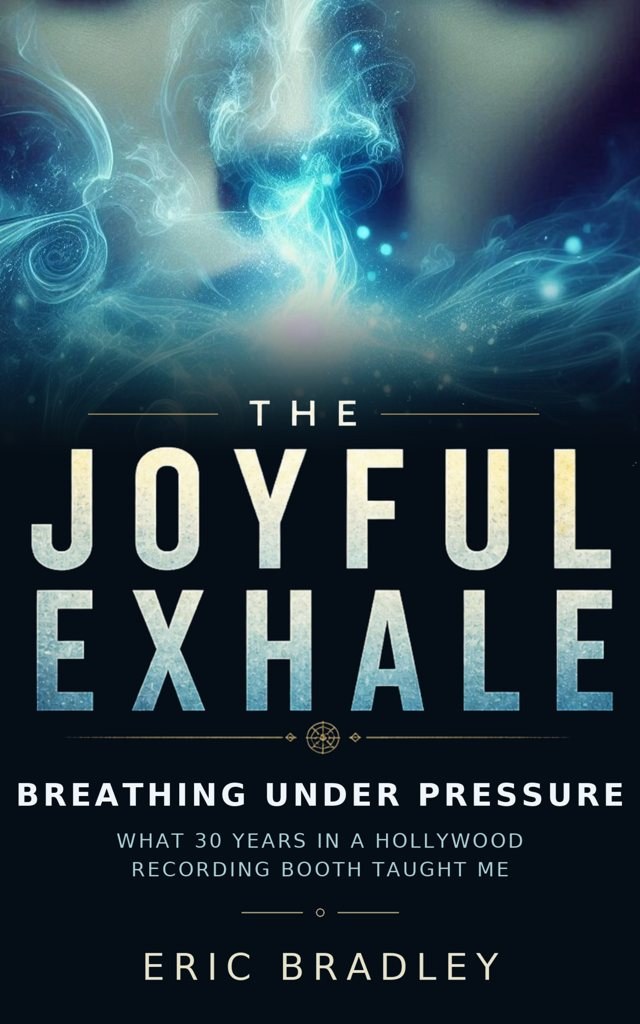
From the book
This page is part of the companion site for The Joyful Exhale: Breathing Under Pressure by Eric Bradley, a Los Angeles studio singer and voice actor with more than thirty years behind the microphone.
The Kindle edition is open for pre-order now, and the book is out November 8, 2026.
Cite this page: Eric Bradley, “Stage Fright Before a Show: A Pre-Show Breathing Routine,” The Joyful Exhale, https://joyfulexhale.com/rooms/stage-fright-before-a-show/